
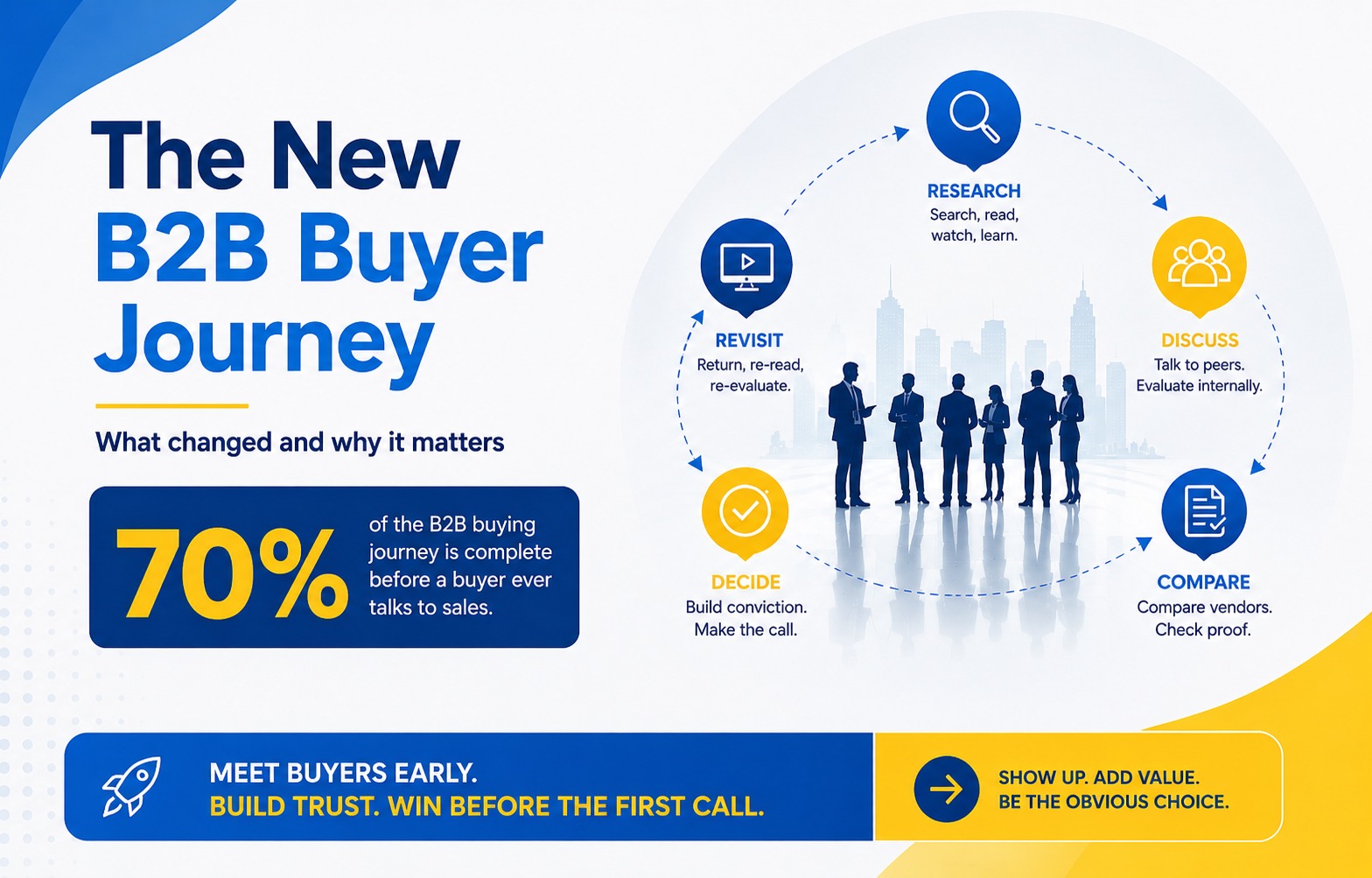
What changed and why it matters
The B2B buyer you sold to five years ago is gone. Today's buyer researches on their own, talks to peers, checks reviews, and reads content long before they talk to your sales team. By the time they fill out a form, they have already made up most of their mind.
This shift is not small. It changes how you plan marketing, how you train sales, and how you measure results. Here is what changed, why it happened, and what you need to do about it.
70%
of the B2B buying journey is complete before a buyer ever talks to sales.
What changed
1. Buyers do their own research first
Buyers do not wait for a sales call. They search, read reviews, watch demos, and compare vendors on their own time. Your website, your content, and your reviews now do the job your sales team used to do in the first meeting.
2. The buying group got bigger
A single decision maker rarely signs off alone. Most B2B deals now involve a buying group of six to ten people, spanning finance, operations, IT, and leadership. Each person looks for different proof before they say yes.
3. Trust replaced pitch
Buyers are tired of sales pitches. They trust case studies, peer reviews, and independent content more than a rep's claims. If your brand shows up with real proof and plain answers, you win attention. If you show up with a pitch, you lose it.
4. The journey is not a straight line
Buyers move back and forth between research, comparison, and internal discussion. They loop back to your website weeks after the first visit. The old funnel, with its neat stages, does not match how people actually buy anymore.
5. Content does the selling
Blog posts, case studies, LinkedIn posts, and comparison pages now carry the weight that a sales deck used to carry. If your content is thin or outdated, buyers move to a competitor who explains things better.
Why this happened
Three forces pushed this shift.
• Remote and hybrid work made in person sales calls harder to schedule, so buyers turned to self-serve research.
• The amount of free information online grew fast, so buyers no longer need a rep to explain the basics.
• Younger decision makers, who grew up searching and comparing online for everything, now sit in the buying group.
Why it matters for you
If your marketing and sales still follow the old model, you are losing deals before you even know a buyer looked at you.
• If your website does not answer the buyer's questions clearly, they leave and do not come back.
• If your sales team is the first source of information, you are already behind. The buyer wanted that information three steps ago.
• If you do not show up on the channels your buyers actually use to research, like LinkedIn and search, a competitor fills that gap.
What to do about it
Build content for every person in the buying group
Finance wants numbers. Operations wants proof it works day to day. Leadership wants the big picture. One generic page will not convince all of them. Build content that speaks to each role.
Put proof ahead of claims
Case studies, data, and client results carry more weight than any tagline. Show the outcome first, then explain how you got there.
Show up before the buyer searches for you
Regular LinkedIn posts, clear blog content, and strong search visibility keep your brand in front of buyers during the research phase, not just at the end.
Align sales and marketing on the same story
If your content says one thing and your sales team says another, buyers notice. Keep the message consistent from the first search to the final call.
Track the whole journey, not just the last click
A buyer might read five blog posts, watch a demo video, and check three LinkedIn posts before filling out a form. If you only credit the last touchpoint, you miss what actually moved the deal forward.
The Bottom Line
The B2B buyer journey changed because buyers changed. They research more, trust less, and decide in groups. Brands that meet buyers with clear, honest, useful content at every stage win the deal before the first sales call even happens.
Brands that keep waiting for the buyer to come to them are already behind.