
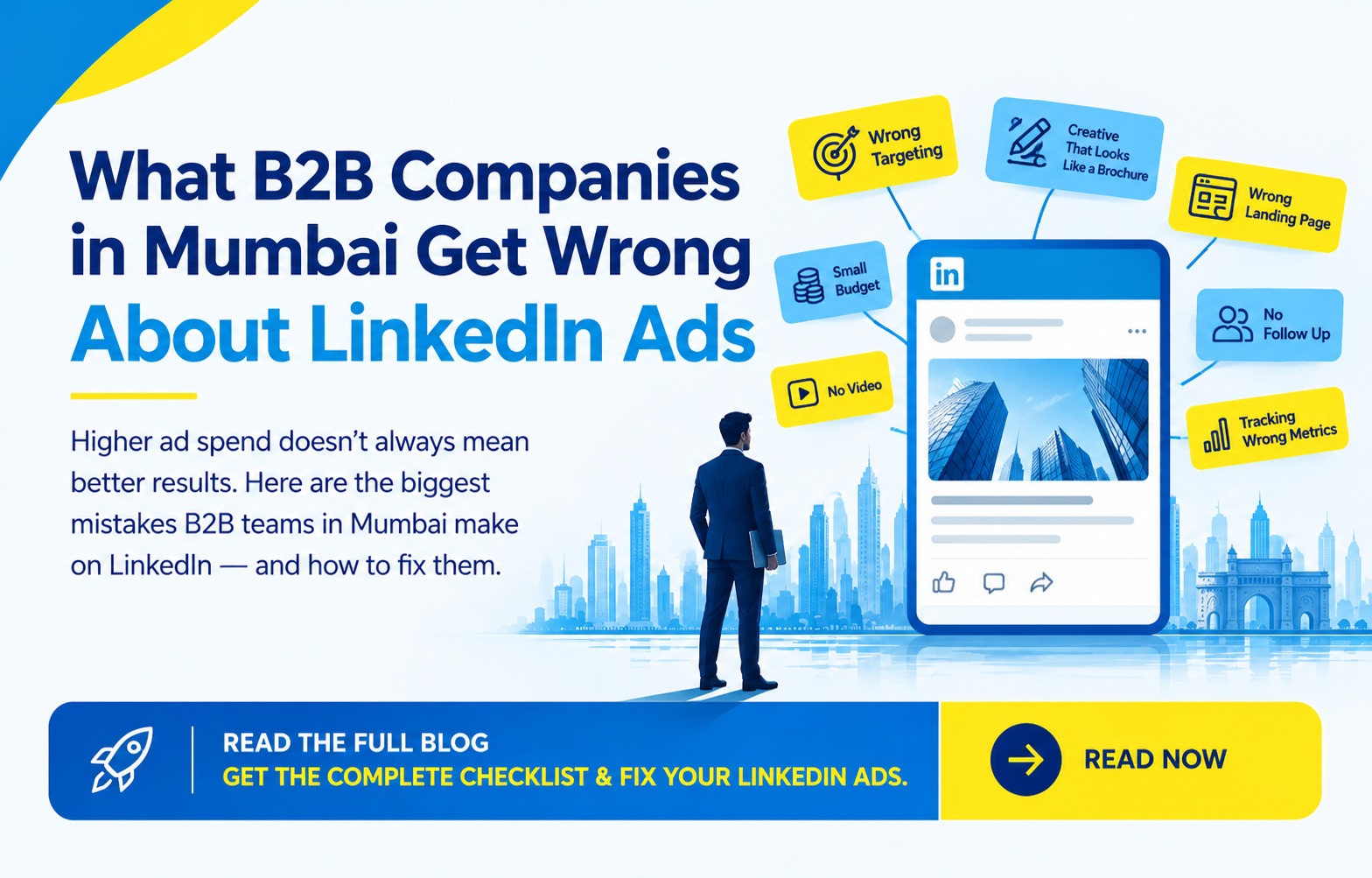
LinkedIn ad spend from Indian B2B companies is rising every quarter. Mumbai leads that spend, because most head offices, finance firms and industrial exporters sit here. But spend going up does not mean results are going up. Most B2B teams in the city are still making the same mistakes on LinkedIn. Here are the ones that cost the most.
1. They Run LinkedIn Like a Search Platform
Google Ads works because people are already searching for a solution. LinkedIn does not work that way. Nobody logs in looking to buy ERP software or industrial valves. They are checking updates from their network.
Teams that treat LinkedIn like Google Ads write copy aimed at someone ready to buy today. That audience is a small slice of the total. The rest of the audience gets ignored, and with it, most of the budget's potential.
Fix this by building a funnel. Run awareness content first. Retarget engaged viewers with a stronger offer. Save the hard sell for the third or fourth touch, not the first.
2. Targeting Is Too Wide
A common setup: target all of Mumbai, job titles like Manager and above, company size 50 to 5000. That is not targeting. That is a mailing list.
LinkedIn charges a premium because it lets you target by function, seniority, company, and skills together. Companies that skip this combination pay LinkedIn prices for Facebook precision.
• Narrow by function and seniority together, not one or the other
• Build separate campaigns for founders, department heads, and individual contributors
• Exclude your own employees and existing clients from cold campaigns
3. Creative Looks Like a Brochure
Most B2B ads on LinkedIn in Mumbai use the same visuals as their company brochure. Stock photos of handshakes. Logos in a grid. A headline that reads like a mission statement.
LinkedIn is a feed. People scroll past anything that looks like an ad. Creative that looks like a normal post, a quote, a chart, a short claim, gets more attention than a polished corporate slide.
Text on the image should say one thing clearly. Not five value propositions squeezed into one banner.
4. The Landing Page Kills the Click
The ad promises a specific answer. The click lands on the company homepage. The visitor has to hunt for the thing the ad promised. Most leave before they find it.
Every campaign needs its own landing page. Match the headline. Match the offer. Cut the navigation menu so there is one action to take, not ten.
5. They Chase Leads Before Building Trust
Cold audience, straight to a demo request form. That is the standard setup for a first campaign. Conversion rates stay low because nobody hands over contact details to a company they have never heard of.
A better order:
• First touch: a useful post or short video, no form
• Second touch: a case study or data point, still no form
• Third touch: the demo or consultation offer, now to a warmed audience
6. Sales Does Not Follow Up in Time
Marketing generates a lead. Sales calls back three days later. By then the prospect has moved on or spoken to a competitor. This gap is one of the biggest reasons B2B teams call LinkedIn Ads a waste of money, when the real problem sits in the handoff.
Set a response window. Under one hour for hot leads, same day for everything else. Track it like a metric, not a courtesy.
7. Budget Is Too Small to Matter
Some companies run 15,000 rupees a month and expect a pipeline of qualified leads. LinkedIn's minimum viable frequency needs more than that to reach even one focused audience segment properly.
Better to run one segment well for two months than five segments badly for two weeks. A smaller, sharper campaign beats a spread-thin one every time.
8. Nobody Tests Anything
One ad, one audience, left running for months. No comparison, no data on what actually works. Teams then decide LinkedIn does not work for their industry, based on a single untested campaign.
Run at least two creative variations and two headline variations per campaign. Check performance every two weeks. Kill what underperforms, scale what works.
9. They Skip Video Entirely
Most B2B campaigns in Mumbai run static images or a PDF carousel. LinkedIn pushes video harder in the feed than any other format. Teams that skip it are fighting for attention with one hand tied.
Video does not need a studio. A founder talking for 40 seconds about one client problem beats a polished animation nobody finishes watching. Keep it under a minute. Put the point in the first three seconds, since most people scroll before that.
10. Every Message Reads the Same
Sales Navigator outreach and InMail campaigns often use one template for every prospect. A finance head and an operations head get the identical opening line. Response rates stay flat because nothing in the message signals it was written for them.
Reference the industry, the role, or a recent post from the prospect in the first line. It takes an extra minute per message. It is the difference between a reply and an ignore.
11. They Track the Wrong Numbers
Impressions and click through rate look good in a monthly report. Neither one tells you if the campaign built pipeline. Teams that stop at these metrics keep funding campaigns that generate attention and nothing else.
Track cost per qualified lead and cost per meeting booked instead. Those numbers connect the ad spend to revenue. If marketing cannot report on them, sales will not trust the leads that come through.
12. They Pull the Budget Too Early
A campaign runs for four days, shows a handful of clicks, and gets paused. LinkedIn's delivery system needs time to find the right slice of an audience. Cutting a campaign in the first week almost always happens before the algorithm has finished learning.
Give a new campaign at least two full weeks before judging it. Change one variable at a time after that, audience, creative, or offer, not all three together.
13. Paid Runs Alone, With No Organic Support
Some teams treat the paid campaign as the whole strategy. The company page stays quiet. Employees never share a post. A cold prospect who clicks an ad and then checks the company page sees no recent activity, which reads as a company that is not really active.
Ask two or three senior people at the company to post about the same theme the ad campaign is running. It costs nothing and it backs up the ad with proof the company is active and credible.
The Practical Checklist
• Build a three-stage funnel, not a single cold ad
• Combine seniority and function in targeting, always
• Design creative that looks native to the feed, not a brochure
• Send clicks to a matching landing page, never the homepage
• Warm the audience before asking for contact details
• Set a sales follow up window and hold the team to it
• Commit real budget to fewer, sharper segments
• Test creative and headlines every campaign, without exception
• Add video, even a simple unscripted clip, to every campaign
• Personalize the first line of every outreach message
• Track cost per qualified lead, not just clicks and impressions
• Give every campaign two weeks before judging results
• Back paid campaigns with organic posts from company leaders
LinkedIn Ads work for B2B in Mumbai. The companies getting results are not spending more. They are running the funnel properly, matching creative to the platform, and closing the gap between marketing and sales. Everyone else is paying for reach that never turns into pipeline.