
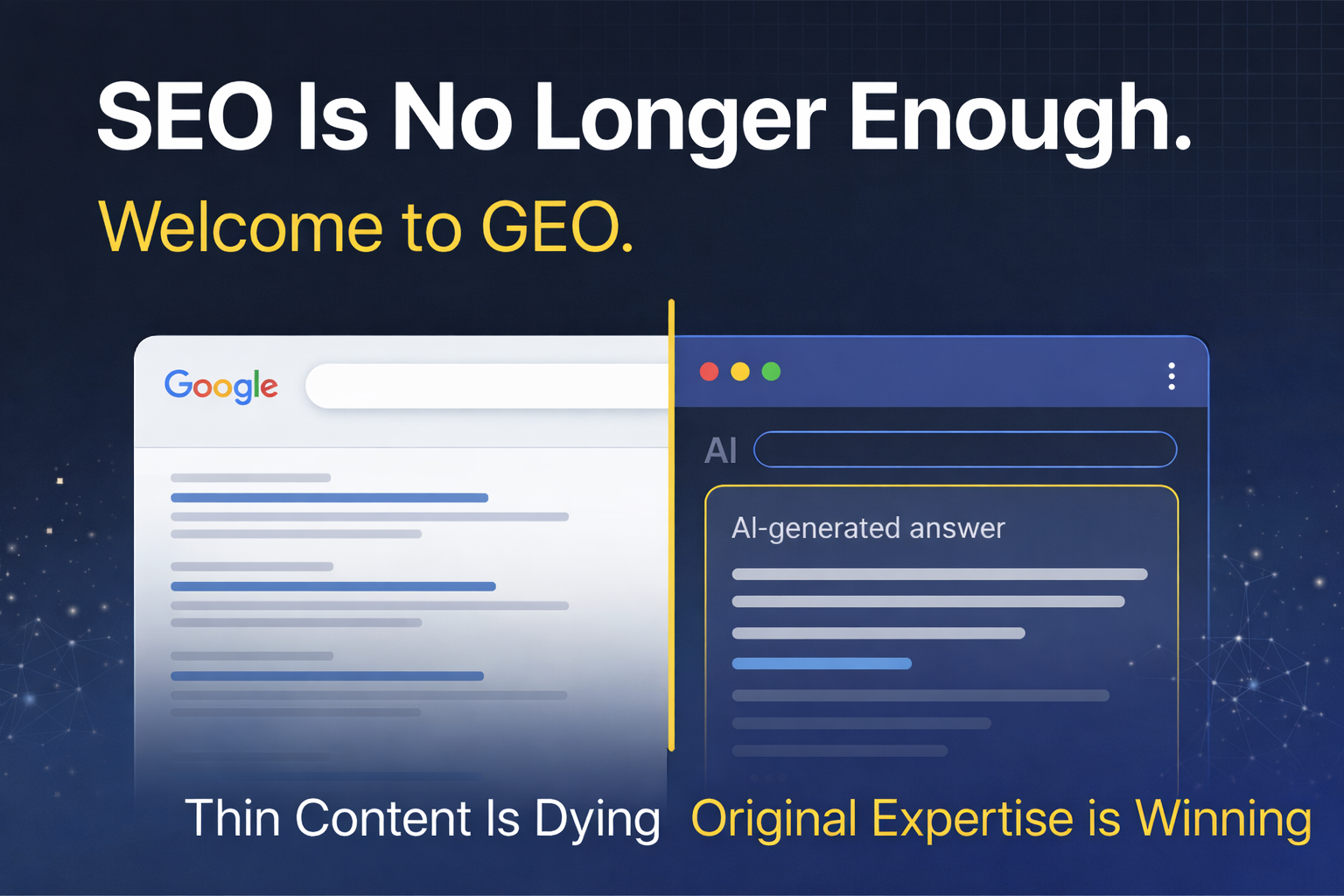
The New Frontier of Digital Visibility
As AI systems answer more questions directly, being cited in an AI's response may matter more than ranking first on Google.
What Is GEO?
Generative Engine Optimization (GEO) is the practice of optimizing your content so it gets cited, surfaced, or summarized by AI systems like ChatGPT, Google’s AI Overviews, Perplexity, Claude, and similar large language model (LLM)-powered tools.
Where traditional SEO (Search Engine Optimization) focused on ranking high in a list of blue links, GEO focuses on becoming the source that AI systems trust, quote, and reference when generating answers.
SEO = Getting to the top of a results page.
GEO = Getting inside the AI's answer itself.
SEO vs. GEO: What's Different?
Traditional SEO
Rank in search results
Backlinks & keywords
Click-through rate
Crawler-optimized pages
GEO (New)
Be cited in AI answers
Authority & clarity
Brand visibility in AI
Factual, well-cited prose
Why GEO Matters Now
The numbers are staggering. AI-powered search is growing at a pace that’s disrupting decade- old assumptions about web traffic:
Google’s AI Overviews now appear in over 50% of searches in some categories
ChatGPT serves hundreds of millions of users monthly, many using it as a first-stop research tool
Perplexity AI has seen explosive growth as an “answer engine”
Traditional organic click-through rates are falling as AI summaries answer queries without requiring a click
If your content isn’t structured for AI consumption, you’re invisible to a fast-growing share of information seekers - even if you rank #1 on Google.
How GEO Differs from SEO
The 6 Core Pillars of GEO
1. Authority and Trustworthiness
AI systems prioritize sources that are widely cited, linked by authoritative domains, and consistent over time. Include author bios with credentials, cite sources, and build backlinks from respected institutions.
2. Clear, Structured Content
LLMs parse content differently than humans do. Organized headings, plain language, bullet points, and direct answers perform well. Answer questions directly and early - don’t bury the key insight – lead with it.
3. Original Research and Data
Being the original source of a fact or study is one of the fastest paths to AI citation. Publish original surveys, coin industry terms, and share proprietary data.
4. Topical Depth and Coverage
Ten deeply researched articles outperform a hundred shallow ones. Build topic clusters, answer related questions, and go beyond surface-level takes.
5. Schema Markup and Technical Structure
Wikipedia, Wikidata, LinkedIn, Google’s Knowledge Graph, Crunchbase - AI Structured data signals to AI what kind of content it's reading. Implement FAQ, Article, and How To schema. Keep HTML clean and metadata accurate.
6. Brand Mentions Across the Web
AI builds a picture of your brand from Wikipedia, industry publications, reputable blogs, and social signals - not just your own site. Pursue earned media consistently.
GEO Audit Checklist
Use this to evaluate your content’s GEO-readiness:
Main question answered within the first 100 words
Page cites credible external sources
Original data, research, or expert insight present
Headings phrased as natural questions
Content goes deeper than a typical Google result
Brand mentioned and linked across the web
Author identified with relevant credentials
Content updated within the last 12 months
Common GEO Mistakes to Avoid
Keyword stuffing for bots. LLMs don’t respond to keyword density the way crawlers do. Over-optimized content reads as low quality.
Thin or generic content. If it could have been written by anyone about anything, AI won't prioritize it. Specificity and originality win.
Ignoring conversational formats. AI systems are trained on natural language. Direct Q&A formats and plain phrasing perform significantly better.
Not monitoring what AI says about you. Set up tracking. Strengthen the sources being cited. Correct inaccuracies where possible.
"The brands that invest in authority, depth, and trust today are positioning themselves to win the AI-driven web of tomorrow."