
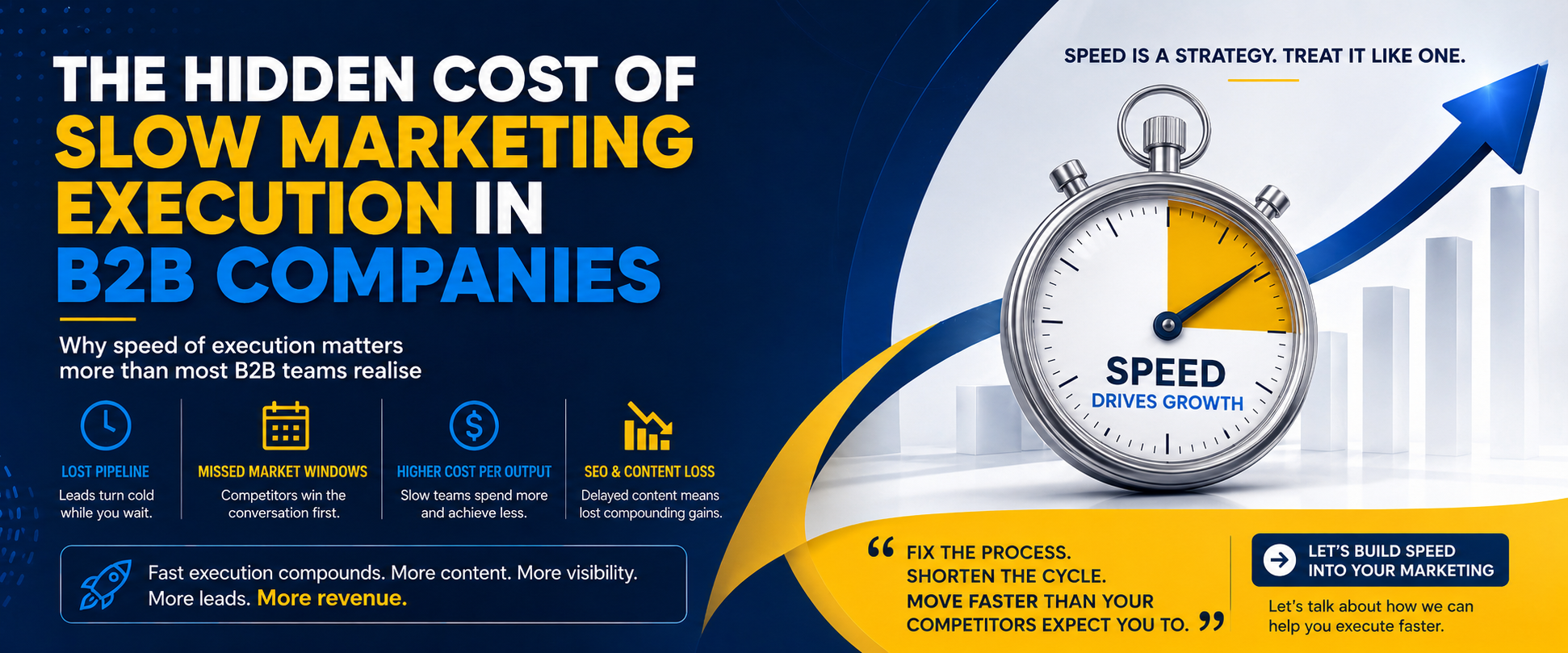
Why speed of execution matters more than most B2B teams realise
Your competitors are not always beating you with a better product. Sometimes they are winning because they move faster.
In B2B marketing, slow execution is one of the most expensive problems a company can have. It does not show up on a balance sheet. There is no invoice for it. But it costs you leads, conversions, and revenue every single month.
Here is what that cost looks like, and what you can do about it.
What "slow execution" means
Slow execution is not just about missing deadlines. It is about the gap between when an idea is approved and when it reaches your audience.
In B2B companies, that gap is usually filled with:
• Multiple rounds of internal approvals
• Waiting on agency briefs and revisions
• Content that sits in a review queue for two weeks
• Campaigns that launch after the relevant moment has passed
A LinkedIn post about a trending industry topic that goes live 10 days after the trend peaked does nothing for you. A case study published three months after the project closed loses its impact. Timing is part of the message.
The actual cost, broken down
Let us get specific. Here are the areas where slow execution quietly drains your marketing returns.
1. Lost pipeline from delayed lead follow-up
Research from Harvard Business Review shows companies that respond to a lead within one hour are seven times more likely to qualify that lead than those who wait even two hours. Most B2B teams take 42 hours on average.When your marketing team is slow to produce follow-up content, nurture sequences, or campaign assets, your sales team is left waiting. And prospects go cold fast.
2. Missed market windows
B2B buying cycles have trigger moments. A regulatory change. A new compliance requirement. A shift in interest rates. A competitor shutting down.If your team takes four weeks to build a campaign around a trigger event, you have missed the window. Your competitor who moved in week one already owns that conversation in the buyer's mind.
3. Higher cost per output
Slow teams are expensive teams. When a campaign takes three times longer to produce, you are paying for more hours, more meetings, and more revisions. You get less output for the same budget.A study by McKinsey found that companies with fast marketing execution cycles get 3x more output per dollar than those with slow, approval-heavy processes.
4. SEO and content compounding loss
Content marketing works on compounding returns. A blog post published today starts indexing this week and builds authority over months. A blog post delayed by eight weeks loses eight weeks of compounding.At scale, that delay across 20 pieces of content per quarter adds up to a significant SEO gap that takes months to close.
Why B2B teams are slow in the first place
The problem is rarely effort. Most marketing teams are working hard. The problem is structure.
• Too many approval layers for every piece of content
• No clear brief process, so briefs get rewritten multiple times
• Agency dependencies with long turnaround times
• Lack of pre-approved templates and brand guidelines
• Decision-making spread across too many stakeholders
The result is a team that is always busy but rarely fast.
What fast execution looks like
Fast does not mean rushed. It means removing friction from the process without lowering quality.Companies with strong marketing execution tend to share a few things:
Clear content frameworks
They do not start from scratch for every piece. Templates, tone-of-voice guides, and pre-approved formats mean writers can move fast without waiting for direction.
Lean approval processes
One or two approvers, not five. A 24-hour turnaround expectation on reviews. Clear criteria for what needs approval versus what can go live directly.
Execution partners, not just vendors
The difference between an agency that executes and an agency that just takes briefs is real. The right partner is plugged into your business context, anticipates your needs, and moves with you, not after you.
Content calendars with buffer built in
The best teams plan four weeks ahead and have a buffer for reactive content. They are never scrambling because the calendar is already populated.
A quick self-audit for your team
Ask these questions about your current marketing operation:
• How long does it take from a brief to a published piece of content on average?
• How many people need to approve a standard social post?
• When was the last time you reacted to a market moment within 48 hours?
• What percentage of your campaigns launched when they were planned to?
If your answers make you uncomfortable, slow execution is already costing you.
The compounding advantage of speed
Here is the thing about fast execution. It does not just save money. It creates compounding advantages.
When you move fast consistently, you publish more content. More content means more indexing, more shares, more touchpoints with your audience. Your brand becomes present in more conversations.
When you respond to market moments fast, you build a reputation for being current and relevant. Buyers notice that. Over time, it becomes a trust signal.
When your campaigns launch on time, your sales team gets better-qualified leads earlier in the quarter. That gives them more time to close.
Speed is a strategy. Treat it like one.
The bottom line
Slow marketing execution is not a minor inefficiency. It is a growth problem in disguise.
Every week a campaign is delayed, every trend you are late to, every follow-up sequence that takes too long to build, those are not just missed opportunities. They are real revenue that goes to someone else.
The B2B companies growing fastest in 2025 are not just the ones with the biggest budgets. They are the ones that execute the fastest with what they have.
Fix the process. Shorten the cycle. Move faster than your competitors expect you to.