
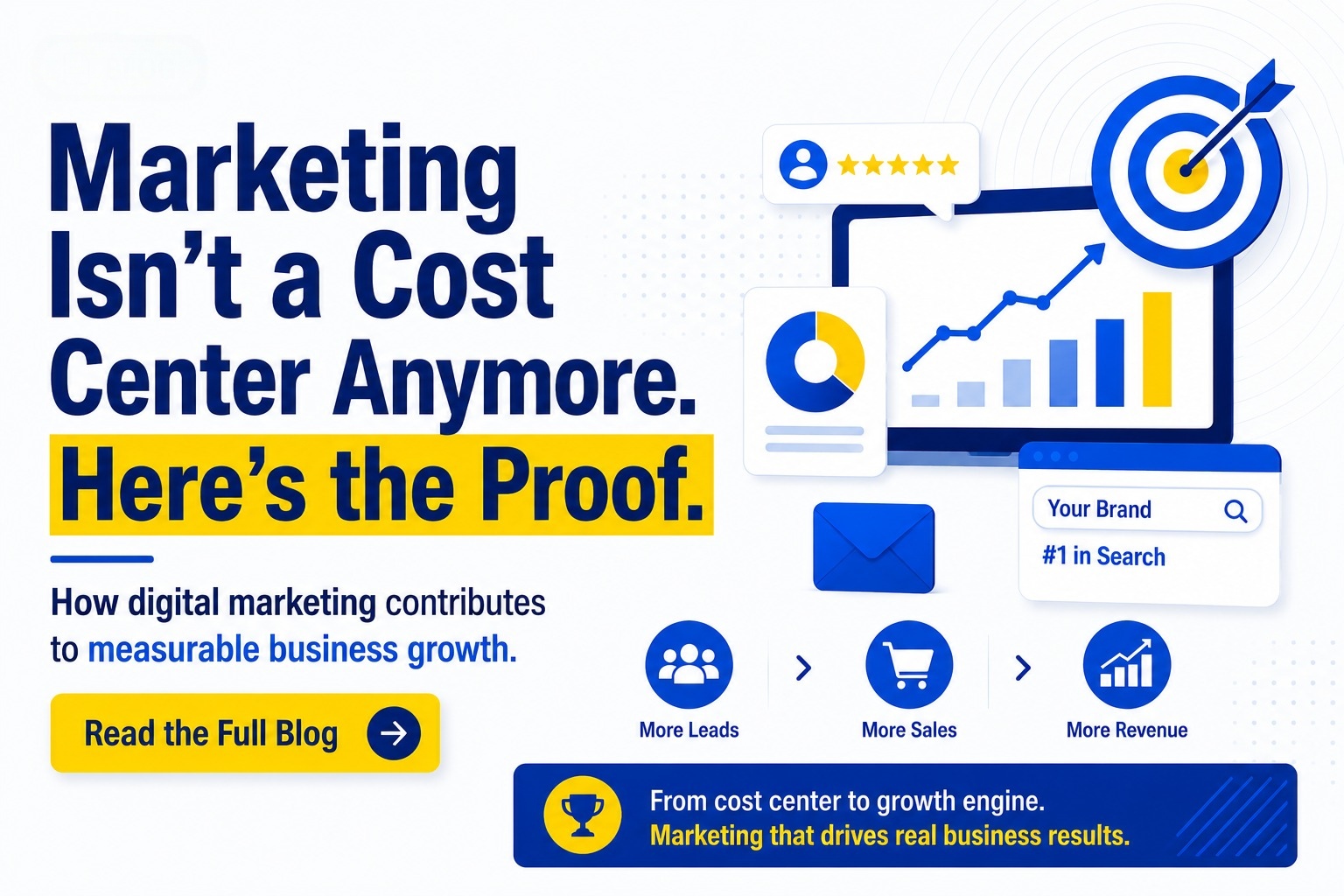
How digital marketing contributes to measurable business growth
For years, finance teams looked at marketing as the department that spent money without proof of returns. They weren't entirely wrong. Old marketing was hard to track. You bought a billboard, ran a TV ad, and hoped customers showed up.
Digital marketing changed that. Every click, every form fill, every purchase can be tied back to a campaign. The data is there. And the numbers tell a clear story: marketing is no longer overhead. It is revenue infrastructure.
Here is what the evidence says.
The Old Argument Against Marketing
The cost center label stuck for one reason: attribution was weak.
Traditional marketing had no clean feedback loop. Spend went in. Revenue came out somewhere. Whether the two were connected was largely guesswork. CEOs and CFOs made budget cuts to marketing first because the link between spend and outcome was loose.
That argument no longer holds in the digital world.
Digital Marketing Has a Receipts Problem (In a Good Way)
Digital campaigns generate data at every stage. You know exactly:
• How many people saw your ad
• How many clicked
• How many filled a form, called your team, or made a purchase
• What each of those actions cost you
• What revenue each action eventually generated
This is called performance marketing, and it has turned marketing from a faith-based budget item into a measurable growth engine.
Google, Meta, and LinkedIn all provide campaign-level reporting down to cost per lead and cost per acquisition. When your cost per acquisition is lower than your customer lifetime value, marketing is producing profit, not consuming it.
The Numbers That Make the Case
Look at what the research says:
SEO returns compounding revenue
Organic search drives over 53% of all website traffic across industries, according to BrightEdge research. Unlike paid ads that stop the moment your budget runs out, SEO content keeps ranking and pulling in leads for months or years after it is published. A single well-optimized blog post can generate qualified leads indefinitely. The cost per lead drops over time while the output stays steady.
Email marketing has the highest ROI of any channel
The Data and Marketing Association consistently reports email marketing returning Rs. 3,600 or more for every Rs. 100 spent. That is a 3,600% return. No other channel comes close at that scale. For businesses that build and nurture their lists, email is not a cost. It is a revenue channel.
Content marketing cuts cost per lead significantly
HubSpot data shows companies that publish 16 or more blog posts per month get 3.5 times more traffic than companies that publish 0 to 4 posts. More traffic means more inbound leads. More inbound leads means less dependence on expensive outbound sales cycles. Content marketing costs 62% less than outbound marketing and generates roughly three times as many leads.
Paid digital ads give real-time return visibility
Google Ads benchmarks across industries show average conversion rates of 3.75% for search ads. For every 100 people who click your ad, nearly four take an action that matters. Track your average deal size against your cost per click and cost per conversion. The math either works or it tells you where to fix the funnel. Either way, you know. That visibility alone is worth the spend.
Marketing as a Revenue Function: What This Looks Like in Practice
The shift from cost center to revenue function happens when marketing teams start measuring what matters:
• Pipeline sourced by marketing (what percentage of your sales pipeline came from marketing activities)
• Customer acquisition cost (CAC) versus customer lifetime value (LTV)
• Revenue influenced by content, campaigns, and brand touchpoints
• Retention and repeat purchase rates from email and remarketing efforts
When you track these numbers consistently, something changes in the conversation with leadership. Marketing is no longer asking for budget. It is presenting a return on invested capital.
That is a fundamentally different relationship with the P&L.
Where Most Businesses Get This Wrong
Most companies do not fail at marketing because they spend too much. They fail because they treat it like a tap, turning it on when business is slow and off when cash is tight.
Digital marketing compounds over time. SEO rankings take months to build. Email lists take time to grow. Brand recognition across social channels builds through consistent effort, not one-off campaigns.
Businesses that stop and start lose ground to competitors who stay consistent. And when they restart, they are essentially starting from zero again.
The companies that treat digital marketing as a fixed operational cost, the way they treat salaries or infrastructure, are the ones that see compounding growth. The ones that treat it as optional spend fight for scraps.
What a Revenue-Producing Marketing Function Actually Needs
Getting to this point requires three things working together:
• Strategy that connects marketing activity to business outcomes. Not "we will post three times a week" but "we will generate 50 qualified leads per month at a cost below Rs. 1,500 per lead."
• Execution that is consistent and creative. Search algorithms, social feeds, and email inboxes are competitive. Generic content does not move the needle. Quality and consistency together determine reach.
• Analytics that feed back into decisions. Data without action is just reporting. Revenue-focused marketing teams look at the numbers weekly and adjust.
These three elements require people with specific skills, time to do the work well, and tools that capture the data. Most businesses try to do this with one internal generalist and wonder why the returns are low.
The Embedded Model: Why It Works Better Than Freelancers or Agencies
Many businesses solve their marketing resourcing problem by hiring freelancers or engaging a traditional agency. Both have limits.
Freelancers are specialists. You need a writer, a designer, an SEO expert, a paid ads manager, and someone to coordinate all of them. Managing multiple vendors across a single campaign is a project management job in itself. And when deliverables are delayed or quality is inconsistent, there is no single point of accountability.
Traditional agencies handle more, but you get account managers, not embedded teams. The work happens at arm's length. Response times are slow. Context about your business must be rebuilt every quarter.
An embedded studio model works differently. A cross-functional team, including strategists, creatives, writers, and media buyers, sits inside your business cycle. They learn your brand. They understand your sales process. They align their output to your revenue targets, not to deliverable counts.
The result is faster execution, fewer coordination gaps, and marketing that maps to pipeline.
The Bottom Line
Marketing stopped being a cost center the moment it became measurable. And digital made it fully measurable.
When you can track every rupee of spend to a lead, a customer, and eventually a revenue number, marketing is no longer overhead. It is a growth system.
The businesses winning right now are the ones that understood this early, invested consistently, and built their marketing function like they build any other revenue operation: with clear targets, the right team, and the discipline to measure what matters.
If your marketing is still sitting in the cost column, the problem is not the budget. It is the approach.
Imageo Media's STUDIO model gives you a dedicated embedded marketing team built around your revenue targets. Strategy, content, design, and paid media, all under one roof, all tied to your pipeline.