
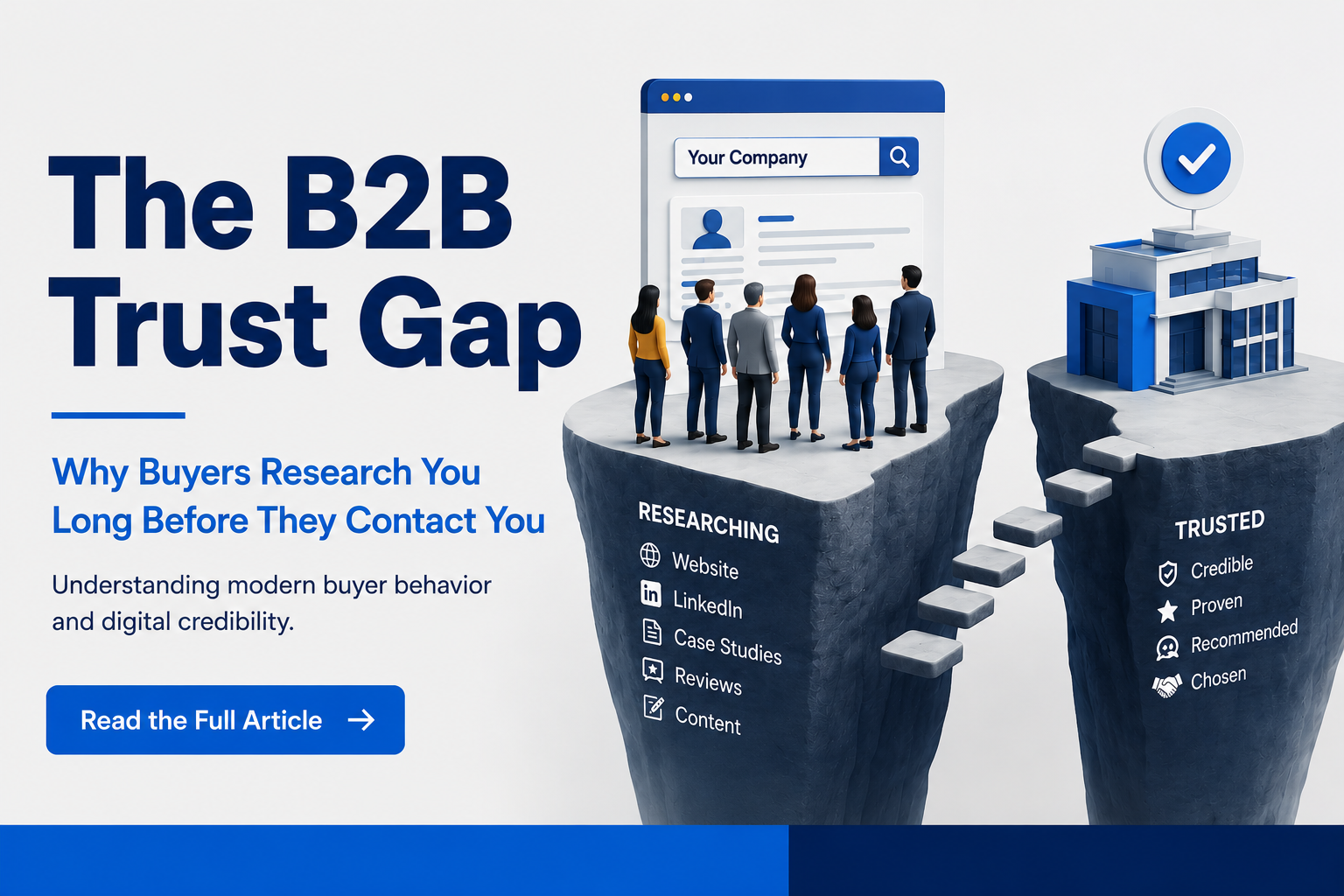
Understanding modern buyer behavior and digital credibility.
Your next client is already looking you up. Right now. Before they fill out your contact form, reply to your cold email, or pick up your call, they have visited your website, read your LinkedIn page, checked your case studies, and formed an opinion.
This is the B2B trust gap. The space between when a buyer first hears your name and when they finally reach out. In that gap, you either win them or lose them. And most companies have no idea it is happening.
The Numbers Tell You Everything
Buyers are doing more research than ever before. A study by Gartner found that B2Bbuyers spend only 17% of their total purchase journey talking to sales reps. The other83% is spent researching independently, comparing options, and building internal consensus without you in the room.
Forrester research puts it even more clearly. 74% of business buyers say they conduct more than half of their research online before making any offline contact. And according to a LinkedIn B2B Institute report, the average B2B buying group now involves 6 to 10decision-makers, all of them doing their own research separately.
You are not being evaluated once. You are being evaluated by multiple people, across multiple touchpoints, over weeks or months, before anyone talks to you.
What Buyers Are Actually Looking For
Buyers are not just checking if you exist. They are trying to answer specific questions in their head. Here is what they want to know, and where they look for the answers.
Can I trust them?
They check your website design and load speed. A slow or messy website signals operational problems. They read your About page. They look for real people with real names and real photos. They search for you on LinkedIn to see if your company page is active. If they find a profile last updated two years ago, they start to wonder.
Have they done this before?
Case studies, client logos, and results are the first things senior buyers look for. Not fluffy testimonials. Actual results. Numbers. Named clients. A 2023 Edelman-LinkedInB2B Thought Leadership study found that 61% of decision-makers said thought leadership content directly influenced their decision to award business to a company. They want proof you have solved their problem before.
Do they know what they are talking about?
Buyers read your blog, your LinkedIn posts, your founder's personal content. They want to see that you have a point of view. Generic content that could have been written by anyone tells them nothing. Specific, informed content tells them you are worth a conversation.
What do other people say about them?
They look for Google reviews, Sort list or Clutch listings, LinkedIn recommendations, and PR mentions. In B2B, word-of-mouth has moved online. A buyer in Delhi will check what someone in Pune said about you six months ago. Third-party validation carries more weight than anything you say about yourself.
The Gap Most Companies Are Ignoring
Most B2B companies invest in getting attention. Paid ads, cold outreach, events, referrals. But they put almost nothing into what happens after someone hears their name.
That is the gap. You got someone curious enough to search for you. And then your outdated website, empty LinkedIn page, and zero case studies quietly talked them out of it.
A DemandGen report found that 97% of B2B website visitors leave without converting. Most of them are not bouncing because your offer is wrong. They are leaving because your credibility signals are weak. Nothing on your site gave them a reason to believe you.
Here is the brutal reality. Your competitors with worse services are winning deals because their digital presence is stronger. Buyers cannot evaluate the quality of your work before hiring you. So, they evaluate the signals that suggest quality. And if those signals are missing, you lose before the conversation even starts.
Where the Trust Gap Shows Up in Real Buying Journeys
Here is a typical B2B buying journey at a mid-size Indian company. Let us say a marketing head at a manufacturing firm is looking for a branding agency.
Week 1: She gets a referral from a friend. She Googles the agency name. The website takes 7 seconds to load. The work section shows only two case studies, both undated. She moves on.
Week 2: She searches for branding agencies in Mumbai. She clicks on three results. One has a clean website with a detailed case study showing a 40% increase in lead quality for an FMCG client. She bookmarks it.
Week 3: She checks the bookmarked agency's LinkedIn. The founder posts every week about branding strategy. She reads four posts. She starts to feel like she knows what the agency thinks. She shows it to her CEO.
Week 4: The CEO looks them up too, separately. He checks their client list, reads one case study, and searches the founder's name. He finds a quote in an industry article. He tells the marketing head to get on a call.
The agency never ran an ad. Never sent a cold email. The only thing that got them into the conversation was what was already online, waiting to be found.
Five Things That Close the Trust Gap
You do not need a massive content operation or a big marketing budget. You need the right things in the right place.
• A website that loads fast, looks clean, and explains who you help and how. No jargon. No generic copy. Just clarity.
• Case studies with real numbers and named clients where possible. Even one strong case study with measurable results beats ten vague testimonials.
• An active LinkedIn company page and founder profile. You do not need to post every day. Two or three strong posts per week, consistently, is enough to signal that you are present and thinking.
• Third-party proof. Get listed on Google Business Profile and Sort list. Ask clients to leave Google reviews. A single external review carries more credibility than a full page of self-written testimonials.
• A clear point of view on your industry. Write about problems you see. Share opinions. Buyers trust people who have something to say, not companies that play it safe.
The Shift You Need to Make
Most B2B marketing is built around interruption. Getting in front of someone who was not thinking about you. That model still works. But it works far better when what that person finds after you interrupt them is convincing.
Think of your digital presence as a silent sales team. It is working around the clock, fielding the questions your buyers are too busy to ask you directly. If it gives the right answers, they come to you ready to buy. If it gives the wrong answers, or no answers a tall, they find someone else.
The buyers who eventually reach out to you have already made a provisional decision. They have already shortlisted you. Your digital presence either kept you on that list or removed you from it.
Closing the trust gap is not a design problem or a content problem. It is a business problem. And the companies that take it seriously are the ones that get called.